2024 Annual Report

Council Promotes Sorghum And Corn Fermented Protein To Mexican Pet Food Industry

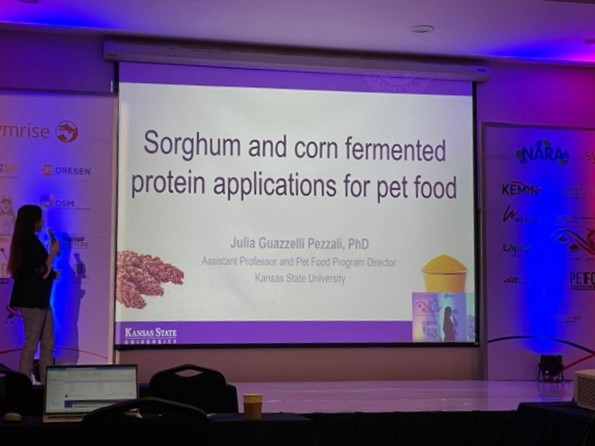
The U.S. Grains Council (USGC) participated in a pet food forum in Guadalajara, Mexico in June to better understand developing trends in the country’s pet market and present on the benefits of incorporating sorghum and corn-fermented protein (CFP) into pet food.

“Pet food production in Mexico has been steadily increasing over the last five years, creating an opportunity to expand U.S. sorghum and CFP exports to supplement the industry’s growth,” said Patricia Esqueda, USGC senior marketing specialist. “The conference was a chance to connect with local industry representatives and tailor the Council’s future promotional strategies accordingly.”

Esqueda was joined by Dr. Julia Pezzali, assistant professor and pet food program director at Kansas State University, who spoke to attendees about the benefits of incorporating CFP and sorghum into pet diets.

The event drew more than 1,000 participants and hundreds gathered for Pezzali’s presentation to learn how to improve the quality of their pet food products.

Other topics included how proper food blends can improve pets’ immune systems, technologies and practices for preserving quality and freshness and the sustainability of pet food formulas.

“Informing attendees about the health benefits of incorporating U.S. sorghum and CFP into pet food diets as the industry is in the early stages of development will be very valuable in the future,” Esqueda said. “Establishing U.S. products as the highest quality option for pet food producers here will create a new market for U.S. farmers that benefits them and the health of Mexican pets.”

Council Joins Partners To Increase U.S. Sorghum Market Share In China

The U.S. Grains Council (USGC) and the United Sorghum Checkoff Program (USCP) joined for a promotional mission to China in June to capitalize on demand for sorghum and present results of a university study on U.S. sorghum’s quality to potential importers.

Sorghum is the primary ingredient in baijiu, the world’s most popular distilled spirit that is widely enjoyed in China. To increase U.S. sorghum exports to the country and help it meet demand for baijiu, the Council commissioned a report from Jiangnan University on the effectiveness of using U.S. sorghum in baijiu production.

“The encouraging findings of this study will be used in Council programs to assure Chinese buyers that U.S. sorghum is a high-quality and abundant resource that will excite producers and consumers alike,” said Manuel Sanchez, USGC director in China. “China is already U.S. agriculture’s largest market, but there is room for even higher sales due to the massive demand for sorghum here.”

Sanchez and USGC Program Manager Ellie Yan welcomed USCP Director Macy Mueller, USCP Director and USGC Asia Advisory Team Lead Adam Schindler and Cargill Sorghum Line Product Manager Kyle Hedrick to Guangzhou, China on June 2 to begin a busy week of meetings and presentations to interested buyers.

Over the next several days, the group visited U.S. Agricultural Trade Office (ATO) staff in Guangzhou and Beijing to coordinate strategies to further increase U.S. market share in the country and met with several major grain import companies to present the results of the study and open channels for future U.S. exports.

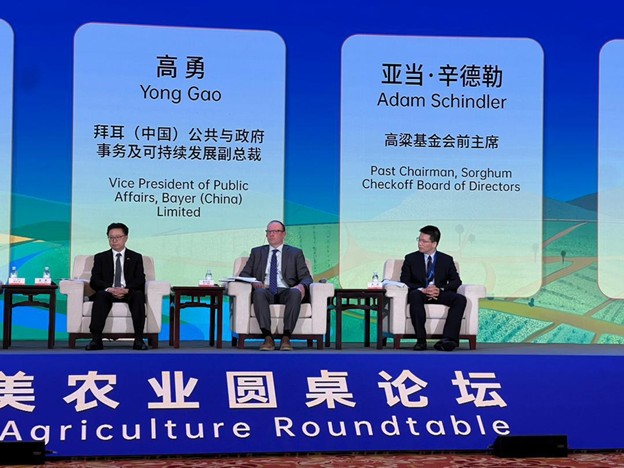
The team traveled to Shandong Province, the largest compound feed producing region in China, for the fourth annual U.S.-China Agriculture Roundtable on June 7. The Council signed an MOU with the Foreign Affairs Office of Shandong Province, agreeing to continue building bridges between Chinese importers and U.S. producers by collaborating on more promotional events. Schindler also presented on U.S. agriculture’s commitment to sustainable farming practices during the morning’s session.

The agenda concluded with another set of meetings with corn and sorghum processing companies in Shandong to understand what their needs for U.S. products are and how the Council and USCP can facilitate purchases.

“This mission was outstanding because it allowed the Council to meet with so many different stakeholders in the export chain, from its promotional planning partners at ATO offices to importers and end-users,” Sanchez said. “I’m glad to have had representatives from USCP and Cargill with us to provide growing and logistical outlooks to buyers and I know everyone will walk away with a much stronger understanding of what the market’s demand is and how U.S. producers can meet it.”

Exploratory Mission To India Showcases Benefits Of U.S. Sorghum

Last January, the U.S. Grains Council’s (USGC’s) India office, in conjunction with the United Sorghum Checkoff Program (USCP) and the National Sorghum Producers (NSP), conducted an exploratory trade mission to India, participating in meetings in six cities over the span of five days. The meetings focused on creating opportunities for U.S. sorghum for human consumption, industrial starch extraction, feed grain applications and ethanol production.

India is facing a potential coarse grain shortage brought on by its growing demographic, below-average monsoon rains and growing corn consumption for animal feed and industrial uses. End users of coarse grains in all forms are looking for consistent opportunities to secure increasingly scarce raw materials. Current Indian import bans of genetically modified (GM) ingredients and a deep cultural history of sorghum use indicate potential for U.S. sorghum to remedy increasing coarse grain scarcity in the most populous country on earth.

“India’s historical use of sorghum in human diets and familiarity with its nutritional benefits provide ample opportunities for inclusion in India’s burgeoning snack food market,” said Jace Hefner, USGC manager of global trade.

The delegation conducted a full analysis of the Indian food sorghum market and supply chain, including visits with small-scale farmers cultivating jowar (Indian sorghum), as well exploring opportunities for inclusion in higher-end food products.

U.S. sorghum’s unique tannin-free characteristics were of particular interest to the Indian feed manufacturing industry. The high tannin content of Indian jowar has historically limited its use in animal feed, and the Indian feed industry is unaware of U.S. sorghum’s differentiating value. The delegation’s educational efforts surrounding U.S. sorghum’s status as a high-quality feedstock will ideally lead to inclusion in India’s rapidly expanding animal feed industry.

The team also spent time touring a starch processing plant, where they were able to present prior research funded by USCP. The research, conducted at the University of Illinois, showcases sorghum’s superior starch yields compared to Indian corn, which is currently the sole raw material for Indian starch manufacturers.

On the final day, the team promoted U.S. sorghum’s use in ethanol manufacturing. India is currently facing many environmental challenges and has recently mandated an E20 blend policy to be achieved by 2025/2026. To achieve this goal, India is looking for feedstocks that are not only affordable, but that also minimize environmental impacts.

“Sorghum stands out as a low-carbon feedstock with several key attributes that make it an ideal choice for sustainable ethanol production in India,” Hefner said. “Sorghum’s lower requirements for water consumption, minimal fertilizer needs, and low-carbon production requirements make it a desirable solution to support India’s climate goals through renewable fuels.”

By capitalizing on these characteristics, the use of sorghum as a low-carbon feedstock for ethanol production aligns with India’s push toward sustainable agriculture and increased environmental stewardship.

The Council will continue to share with India’s industry leaders the merits of U.S. sorghum inclusion across all applicable sectors.

“This was a great first step toward securing opportunities for U.S. sorghum in the Indian market. We saw several instances where sorghum’s value proposition has potential to deliver solutions, and we are excited to see what the future has in store,” said Norma Ritz Johnson, USCP executive director.