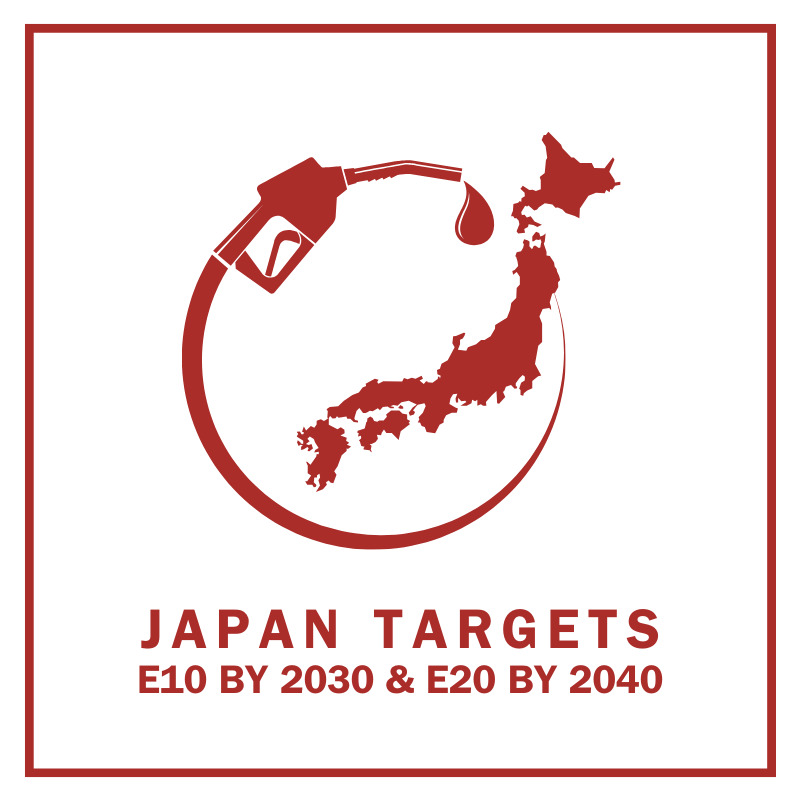
The Japanese government announced its intention for the country’s gasoline to be blended with 10 percent ethanol (E10) by 2030 and E20 by 2040, a move that will have significant benefits for the economic, environmental and human health of Japan and its consumers.
“The U.S. Grains Council (USGC) and its members and partners are delighted at the news of Japan’s steps towards E10 and E20 and applaud its recognition of ethanol’s ability to reduce harmful emissions in our atmosphere,” said Ryan LeGrand, USGC president and CEO. “The Council is ready and willing to support Japan and its transportation sector in any capacity to help the country meet its energy ambitions.”
The Council is a longstanding supporter of biofuel growth in Japan, including recent steps like witnessing the opening of the first E7 fuel pump in Japan and LeGrand’s participation in a USGC and U.S. Department of Agriculture (USDA) conference on sustainable aviation fuel.
The Japanese Ministry of Economy, Trade and Industry (METI) spearheaded the effort as part of its goal for the country to be carbon neutral by 2050.
METI noted that because of Japan’s relatively low domestic production of ethanol, imports will drastically increase from countries including the U.S. and infrastructure improvements will be required as most of Japan’s fuel stations are only equipped for E3 blends.
The government previously set a target of having all vehicles be fully or partially electrified by 2035, but delays to that initiative and Japan’s concentrated efforts to reduce carbon emissions created the need for higher ethanol blending rates.
“Through promotional activities like the USDA/USGC joint conference in October, the Council will continue ensuring the introduction of higher bioethanol blends in Japan and work to make U.S. corn ethanol a major component in supporting Japanese ethanol blending policies,” said Tommy Hamamoto, USGC director in Japan.


An action in the Philippines last week has cemented the country as one of the world’s most progressive ethanol and biofuels markets.
Building on the success of the country’s nationwide mandate to blend gasoline with 10 percent ethanol (E10), implemented in 2013, the Philippines Department of Energy is allowing fuel retailers to increase blending to E20 on a voluntary basis.
The Council has been building relationships with the Filipino transportation sector to foster business connections with U.S. producers to help meet the anticipated rise in demand. Pictured above, representatives from the Philippines National Biofuels Board, a key cross-department policymaking body for ethanol in the Philippines, inspected a blender fuel dispenser offering E10, E20, and E20 fuel blends in Elmhurst, Illinois in June.
“The Department of Energy’s decision to increase the ethanol blend ceiling is a win for the consumers, environment and industry of the Philippines,” said Caleb Wurth, the U.S. Grains Council’s Regional Director for Southeast Asia & Oceania. “The Council and the U.S. ethanol industry are proud partners of the Philippines’s ethanol industry and the Department of Energy as they strive to decarbonize transportation, bolster fuel security and lower pump prices for consumers. We stand ready to assist the Philippines in further ethanol expansion efforts as the Department of Energy aims to scale to a nationwide E20 blend mandate in the coming years.”
The Philippines consumes 1.8 billion gallons of gasoline per year. Ethanol production there has increased nearly 450% since the E10 mandate began in 2013, delivering significant economic benefits to rural communities, alleviating pump prices for consumers and reducing greenhouse gas emissions from the transportation sector by more than 800 kilotons of carbon dioxide annually.
The Philippines and the U.S. have long enjoyed a mutually beneficial relationship throughout the development of the former’s ethanol industry. The Philippines in 2023 imported 55 million gallons of ethanol from the U.S., accounting for 85% of all ethanol imports and 40% of the Philippines’ total ethanol demand. U.S. ethanol imports continue to help lower the average price of ethanol in the country and stimulate further investment in domestic production capacity.
The new E20 policy will immediately increase the potential ethanol demand in the Philippines by 86 million gallons.
The United Kingdom (UK) has emerged as a significant export market for U.S. ethanol. During marketing year (MY) 2023/2024, export volumes of U.S. ethanol destined for the U.K. reached 227 million gallons, surpassing the European Union by 86 million gallons. Although the current MY 24/25 only began in September, ethanol exports of U.S. origin to the U.K. are already up 29 percent year-on-year, placing it as the third largest export destination for U.S. ethanol.
The U.S. Grains Council (USGC) plans to continue encouraging the British government to build on its efforts to increase the use of biofuels to achieve an E10 average blend rate nationwide, removing the current duty on U.S. ethanol and allowing for the inclusion of first-generation biofuels in the context of its SAF mandate.
The country’s burgeoning demand for U.S. ethanol in recent years is largely ascribed to the country’s embrace of ethanol as an effective tool to aid in the decarbonization of its transportation sector. In the U.K., the increased use of ethanol and other renewable fuels is mandated by the Renewable Transport Fuel Obligation (RTFO).
In July 2021, the U.K. Department for Transport (DfT) published its transport decarbonization plan, which seeks to decarbonize all modes of domestic transport by 2050. This initiative preceded the introduction of the country’s mandate that gasoline must be blended with 10 percent ethanol (E10) in September of that year, contributing to an increase in the use of renewable fuel in the U.K.. Building on this momentum and successful rollout in England, Northern Ireland saw E10 implementation in November 2022.
The latest installment in the U.K.’s energy plan relates to sustainable aviation fuel (SAF). Specifically, the SAF Mandate serves as the U.K.’s key policy to decarbonize aviation fuel by encouraging the supply of SAF. The mandate came into effect on Jan. 1, 2025, starting at a modest two percent of total U.K. jet fuel demand, but ramping up on a linear basis to 10 percent in 2030, before reaching 22 percent in 2040. From 2040, the obligation will remain at 22 percent until there is greater certainty regarding SAF supply. The policy also features a sub-mandate on power-to-liquid (PtL) fuels, beginning in 2028.