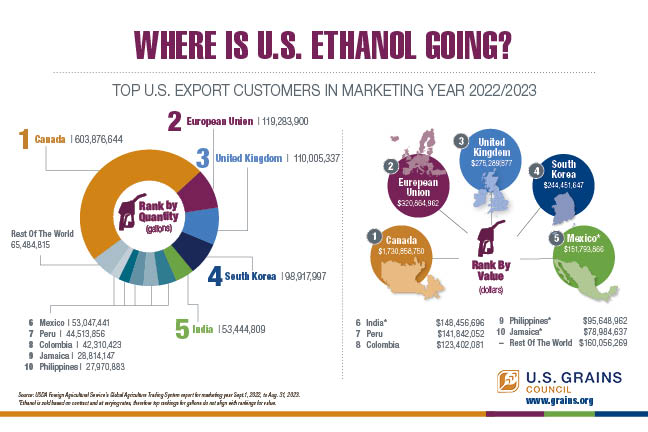
Following the finalization of its Clean Fuel Regulations (CFR) in July 2023, Canada continued its strong hold as the top market for U.S. ethanol in the 2022/23 marketing year (MY), setting records both monthly and yearly, with exports totaling 603.9 million gallons (214.1 million bushels), worth $1.7 billion, up 135.8 million gallons (29 percent) from MY 2021/22.
This is the largest ethanol export year to Canada on record. Further increases are expected as implementation of the CFR continues and provinces such as Quebec and British Columbia set increasingly ambitious biofuel blending policies.
U.S. ethanol exports experienced its fifth-largest marketing year on record in 2022/23, totaling 1.25 billion gallons (423 million bushels), worth $3.5 billion, down 174 million gallons, or 13 percent from MY 2021/22. Record exports to Canada and sizeable gains in the United Kingdom, Peru, Colombia and Jamaica helped offset losses from South Korea, India, the European Union and Mexico.

In 2023, U.S. ethanol exports to Colombia experienced a substantial surge, overcoming the Colombian government’s decision in March to extend the countervailing duty (CVD) for an additional five years. Direct exports to Colombia during marketing year (MY) 2022/23 reached 42.3 million gallons, representing an impressive 235 percent increase from the previous year. Colombia secured the eighth position as a top export destination for U.S. ethanol, ranking third in Latin America, following Mexico and Peru.
Colombia re-emerged as a crucial market for U.S. ethanol in MY 2022/23, rebounding from a contraction in 2021 and 2022 attributed to the CVD, reduced blending mandates and macroeconomic challenges, including the devaluation of the Colombian peso. The recovery of U.S. ethanol exports to Colombia in 2023 was propelled by improved economic conditions, a decline in Colombian ethanol production, and an overall surge in biofuel demand. Throughout the year, the Colombian government persisted in reducing state gasoline subsidies, gradually increasing fuel costs. The Ministry of Mines and Energy (MME) adjusted mandatory blending levels, ranging from three to seven percent, eventually stabilizing at seven percent by the end of 2023. Despite challenges, the upward trend in U.S. ethanol exports to Colombia persisted in late 2023. Since May 2020, U.S. ethanol imports have faced a countervailing duty (CVD) of $0.066/kg ($0.052 per liter). The CVD, extended in March 2023 for five years with a review scheduled for 2026, did not hinder this growth.
“Colombia has proposed increasing the mandatory blend to E10 in 2024. We hope the country will fulfill this commitment, and under favorable economic conditions, we may witness a continued upward trend in U.S. ethanol exports in the upcoming years,” said Marri Tejada, regional director of the Council’s Latin America office.
In 2023, the Council actively collaborated with key stakeholders in Colombia to emphasize the benefits of increasing mandatory ethanol blending, particularly to E10, and recognizing the complementarity of ethanol imports, especially in the Northern region. Additionally, the Council is conducting pilot studies on higher voluntary blends to stimulate ethanol demand in the country.

Before 2018, Japan used only ethanol imported from Brazil for use in automobile fuels. This decision was based on an outdated calculation of greenhouse gas (GHG) emission reduction, which effectively excluded U.S. ethanol. In 2018, the U.S. Grains Council worked with the Japanese government to update the GHG calculation for U.S. ethanol. This resulted in the Japanese government allowing up to 44% inclusion of U.S. ethanol in the fuel sector which translates into 96 million gallons of U.S. ethanol.
Working in collaboration with USDA FAS/Japan and with the Ministry of Economy, Trade, and Industry (METI), the Council was able to raise the inclusion rate twice more – in 2020, it was raised from 44% to 66% and in 2023, U.S. ethanol was given full access to the Japanese fuel ethanol market. These changes were brought about by broad collaboration with FAS and other U.S. Government agencies including U.S. Embassy in Japan and U.S. Trade Representatives to deliver updates on continued improvement in reduction of carbon emission by the U.S. ethanol industry. As a result, Japanese METI revised the U.S. corn ethanol carbon intensity score that allows U.S. ethanol to fully access the entire bioethanol market.
The Council invested a combination of MAP and ATP funding from 2018 to 2023 to open a market that was completely closed to U.S. ethanol. As of 2023, this new market opportunity is worth 217 million gallons of U.S. ethanol annually with an approximate value of $434 million.